
Lufthansa’s First Scheduled Transatlantic Flight with Biosynthetic Fuel
 Hamburg (Germany) – January 11, 2012 – Lufthansa has scheduled the first transatlantic flight with biosynthetic fuel for January 12, 2012. The supply cycle of biosynthetic fuel or how it works with Biosynthetic Fuel.
Shipping & Refining
The pressed vegetable oil was transported by ship to Finland, landing in the Port of Porvoo, near Helsinki. This is the site of Neste Oil’s crude oil and bio refinery, where the oil was further processed. Here the resulting HVO biofuel was mixed with conventional Jet A-1 fuel and then shipped to Hamburg.
Storage & Transport
In addition to sourcing a sufficient quantity of biofuel, the logistics also pose a particular challenge in the project. After the HVO biokerosene arrives in Hamburg, it was stored by the company Haltermann. Lufthansa has leased an above-ground tank at the Port of Hamburg that is specifically equipped for storing aviation fuel. From the tank farm in Hamburg, the HVO biokerosene was transported in tanker trucks to Hamburg Airport.
Biokerosene’s storage behavior is one of the issues closely examined in the context of the project. Beyond the already stringent test for normal aircraft fuel, additional and more frequent checks of the fuel were conducted. The focus here laid on tests for microbial contamination and chemical separation.
Refueling the Airbus
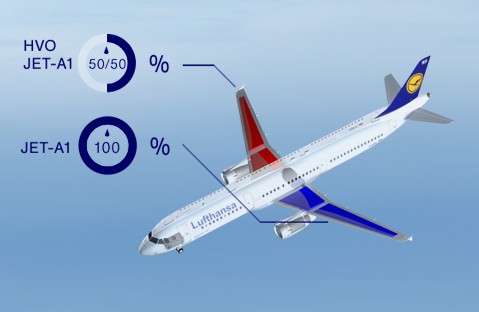
Due to logistical reasons, the Lufthansa Airbus A321 D-AIDG selected for the flight operations is fueled only in Hamburg. After it arrives at Hamburg Airport, the fuel is transported from the tanker trucks through a filtration system into an airfield refueling tanker. This then refuels the Lufthansa A321 D-AIDG alongside a second tanker that refuels the aircraft with regular Jet-A1.
Share of Biokerosene
The right engine of the Airbus 321 D-AIDG was fuelled using conventional JET A-1, the left engine has run on a 50:50 mixt of JET A-1 and HVO biokerosene. Our partner Neste Oil mixed the fuels at their site in Helsinki, thereby ensuring that the mix ratio remained constant throughout the trial.
The Airbus A321 Passenger Aircraft
The Airbus A-321 is the longest model in the A-320 airplane fleet, with just under seven meters extension compared to the basic model. Lufthansa’s configuration provides seating for up to 190 passengers in the short and medium haul jet. The Airbus A-321 excels with its high fuel efficiency and low noise and emissions levels.
The Hamburg – Frankfurt route
Eight times daily on the Hamburg-Frankfurt-Hamburg route, an A-321 D-AIDG had been operated using the new approved fuel mix over a six-month period. In the course of this trial, approximately 1556 tons of biofuel mixture had been used.
The trial for testing the use of HVO biokerosene had no noticeable impact on the Airbus 321 passengers travelling on the Hamburg-Frankfurt route. Flight operations on board and in the cabin remained entirely unaffected by the use of the modified fuel.
For more information, please visit: www.lufthansa.com